 Shopify Migration



Magento 2 Custom Form
 Trending

- for Magento 2.4.x (CE, EE)

Turn your store into a lead and feedback engine. Design any form in minutes, embed it anywhere, and manage every response and reply in one place.
Turn your store into a lead and feedback engine. Design any form in minutes, embed it anywhere, and manage every response and reply in one place.




User Guide
The Custom Forms extension lets you build and manage any kind of form for your Magento 2 store directly from the admin panel – contact forms, feedback forms, quote requests, bookings and more. You choose the fields, decide who is notified, place the form anywhere on your website, and review and reply to every submission from one place.
Features
- Create unlimited forms with an easy field builder: add, remove and reorder fields with a few clicks.
- 19 field types, including text, dropdown, checkbox, radio, date, file upload, rating, address, country
and map. - Multi-page (step-by-step) forms, required fields, tooltips, default values and custom CSS classes.
- Schedule a form for a date range and limit it by store view and customer group.
- Email notifications to the store owner and an automatic confirmation email (autoresponder) to the
customer. - Submitted Data grid with status tracking, detail view, PDF download and replies by email.
- Export a form's submissions to CSV or PDF.
- Place a form on a CMS page/block, in a template, in a layout update, or share its direct link.
- Seven ready-made example forms are installed with the extension.
Steps:

Extension Installation
- Download the zip file
- Extract and put it into /app/code/
- Open Cli in the Magento directory and follow the below commands:
- php bin/magento s:up
- php bin/magento s:d:c
- php bin/magento s:s:d -f
- php bin/magento i:rei
- php bin/magento c:f
- php bin/magento cron:install
- php bin/magento cron:run
- To confirm the module is active, run php bin/magento module:status
Vdcstore_CustomForm. It should be listed under enabled modules. - Where to find it: after installation you will see Content > Custom Forms in the admin menu with two items – Forms and Submitted Data. If a user cannot see them, grant the Custom Forms resource under System > Permissions > User Roles.
Global Configuration :
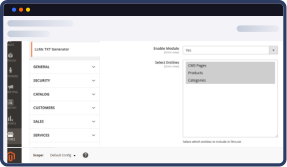
- Global settings apply to all forms. Individual forms can override the email settings (see section 5). Go to Stores > Configuration > VDC STORE > Custom Forms, change the settings below and click Save Config.

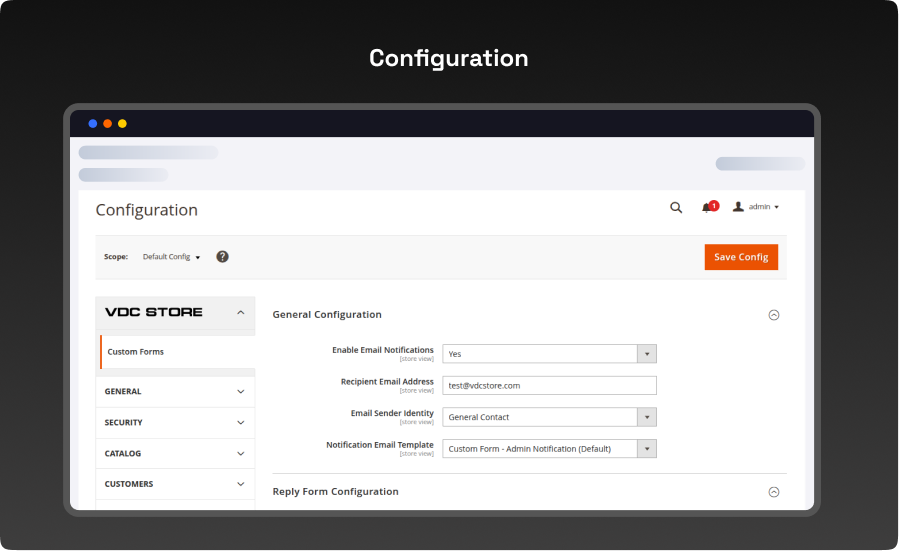
General Configuration :
- Enable Email Notifications – Choose Yes to send an email to the store owner whenever a new form submission is received.
- Recipient Email Address – The email address that receives the new-submission notification.
- Email Sender Identity – The store email identity (for example, General Contact) the notification is sent from.
- Notification Email Template – The email template used for the admin notification. Default: Custom Form – Admin Notification.
Reply Form Configuration
- Reply Email Sender – The store email identity used to send your replies.
- Reply Email Template – The email template used for replies. Default: Custom Form – Reply To Submission.
- BCC Recipient – Optional email address that receives a blind copy of each reply.
Autoresponder
- The extension also allows you to set up automatic responses.
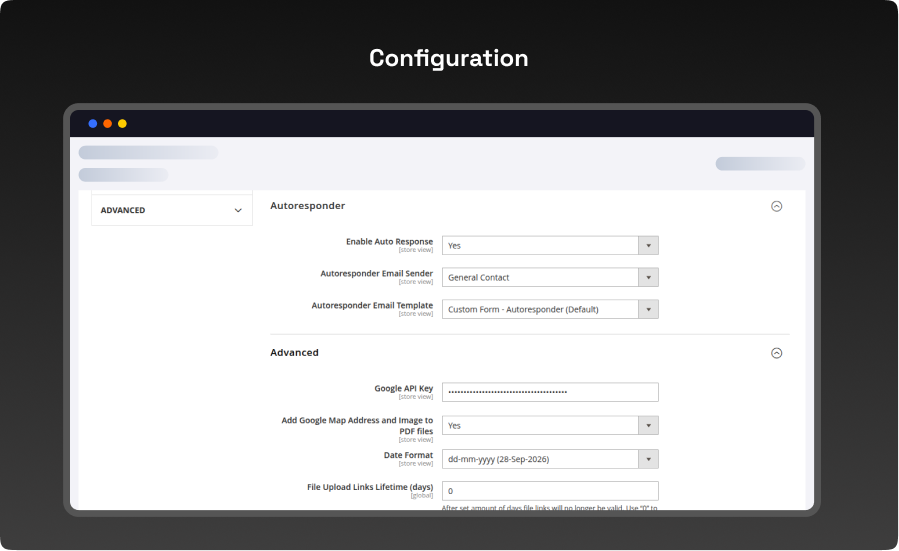
- Enable Auto Response – Choose Yes to automatically send a confirmation email to the customer after they submit a form.
- Autoresponder Email Sender – The store email identity the confirmation email is sent from.
- Autoresponder Email Template – The template used for the confirmation email. Default: Custom Form – Autoresponder.
Advanced
- Google API Key – Your Google API key. It is needed for the Map / Location field and for map images in PDF files.
- Add Google Map Address and Image to PDF files – Choose Yes to include the map address and image in PDF files of submissions.
- Date Format – The date format used to display dates (for example, dd-mm-yyyy).
- File Upload Links Lifetime (days) - Number of days after which download links for uploaded files stop working.Use 0 to disable this limit. This setting applies globally.
Managing Forms
- Go to Content > Custom Forms > Forms. The grid lists all forms, including the seven example forms that come with the extension.
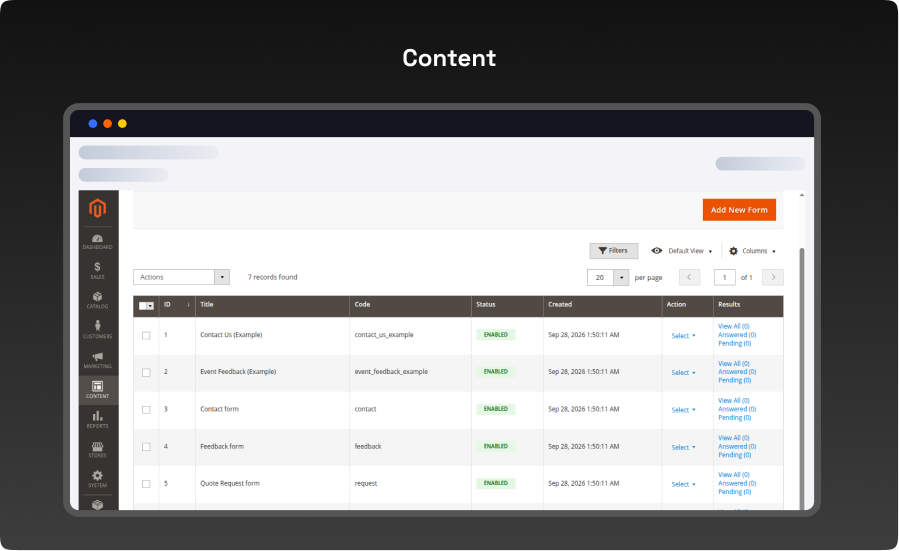
- The grid shows the following columns:
- ID, Title, Code – the form's number, name and unique code.
- Status – Enabled or Disabled.
- Created – the date the form was created.
- Action – open the Select menu to Edit, Duplicate, or export the form's data to CSV or PDF.
- Results – shortcuts to the form's submissions: View All, Answered and Pending, each with a
count.
- Above the grid you can search with Filters, choose the visible Columns, and set the number of records per page. Tick one or more forms and use the Actions dropdown to enable, disable or delete them together. Click Add New Form to create a new form.
- Tip: to reuse a form as a starting point, use Duplicate instead of building from scratch.
Creating and Editing a Form
- Click Add New Form (or Edit on an existing form). The form editor has five tabs: General, Notifications, Content, Creator and Embedding. The buttons at the top of the page are:
- Back – return to the forms grid without saving.
- Delete Form – permanently delete the form.
- Duplicate – create a copy of the form.
- Export Submissions to CSV / PDF – download all submissions of this form (the number of submissions is shown in brackets).
- Save & Continue Edit – save and stay on the page.
- Save Form – save and return to the grid.
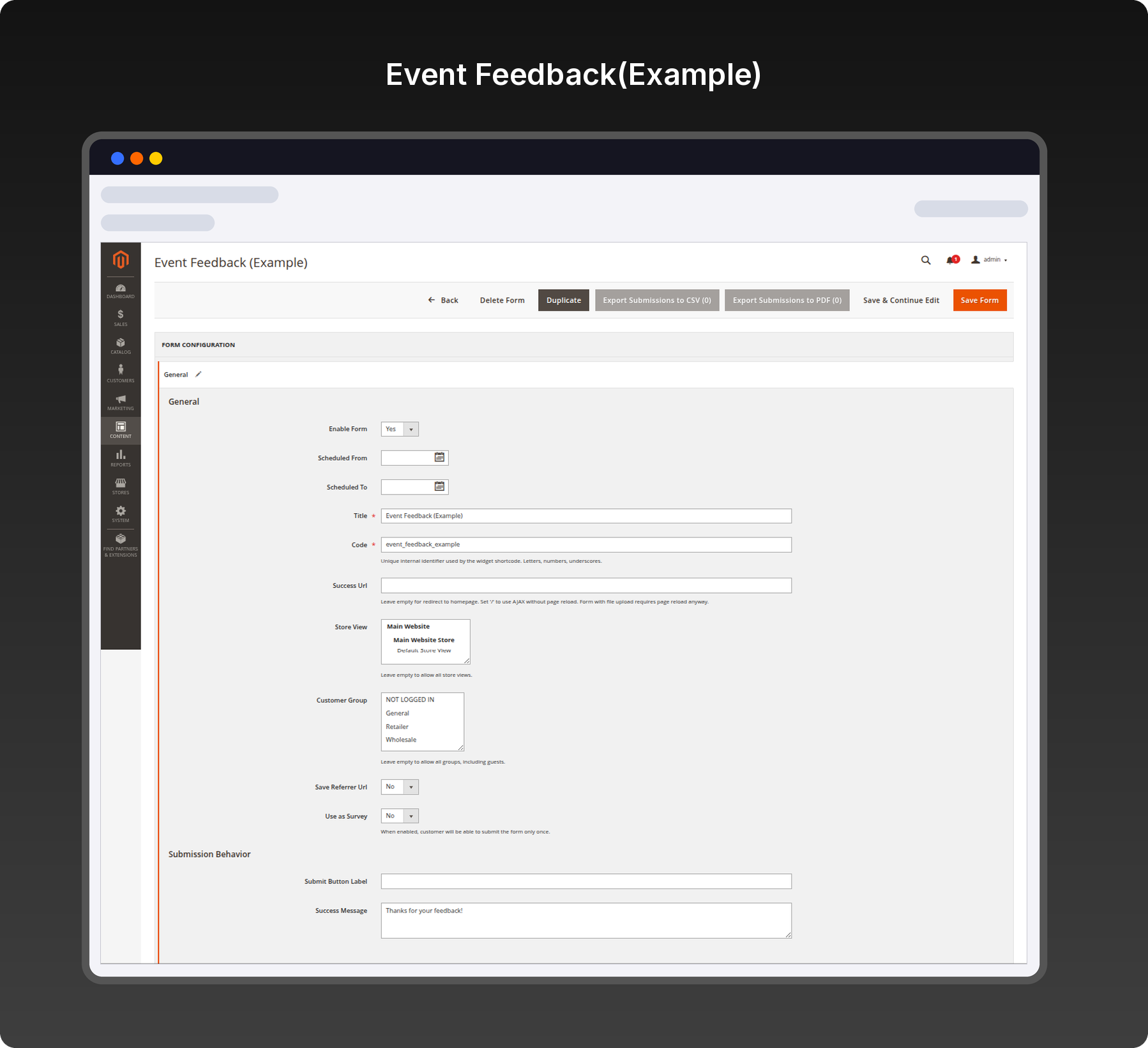
- Enable Form – Set to Yes to show the form on your store, or No to hide it.
- Scheduled From / To – Optional. The form is available only between these dates. Leave empty for no limit.
- Title – The name of the form, shown as the form heading.
- Code – A unique internal identifier used in the embedding code and the direct link. Use letters, numbers and underscores only.
- Success Url – Where to send the customer after submitting. Leave empty to redirect to the homepage. Enter / to submit with AJAX without a page reload (forms with file upload need a page reload anyway).
- Store View – Where to send the customer after submitting. Leave empty to redirect to the homepage. Enter / to submit with AJAX without a page reload (forms with file upload need a page reload anyway).
- Customer Group – Select which customer groups can see the form. Leave empty to allow all groups, including guests.
- Save Referrer Url – Set to Yes to store the page the customer came from with the submission.
- Use as Survey – When Yes, a customer can submit the form only once.
- Submit Button Label – Text of the submit button. Leave empty to use the default (Submit).
- Success Message – The message shown after a successful submission, for example “Thanks for your feedback!”
Notifications :
- These settings override the global values from Stores > Configuration > VDCSTORE > Custom
Forms. Leave a field on -- Use Default -- or empty to use the global setting.
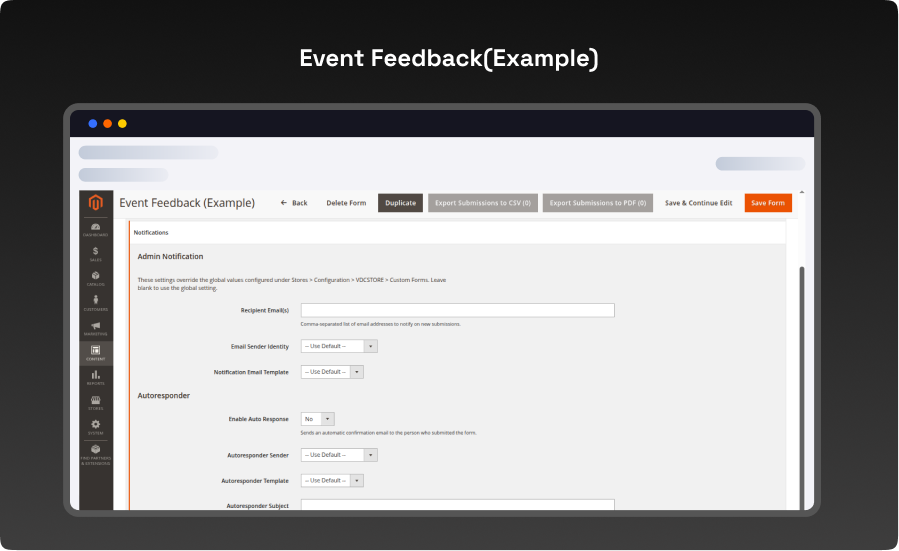
- Recipient Email(s) – Comma-separated list of email addresses to notify about new submissions.
- Email Sender Identity – Sender of the admin notification for this form.
- Notification Email Template – Template of the admin notification for this form.
- Enable Auto Response – Sends an automatic confirmation email to the person who submitted the form.
- Autoresponder Sender / Template – Sender and template of the confirmation email.
- Autoresponder Subject – Subject line of the confirmation email.
- Email Address Field – Choose which form field holds the customer's email address. Required for the autoresponder and for replying from Submitted Data. If the dropdown is empty, add the fields in the Creator tab and save the form first.
Content
- Use this tab to add text around your form.
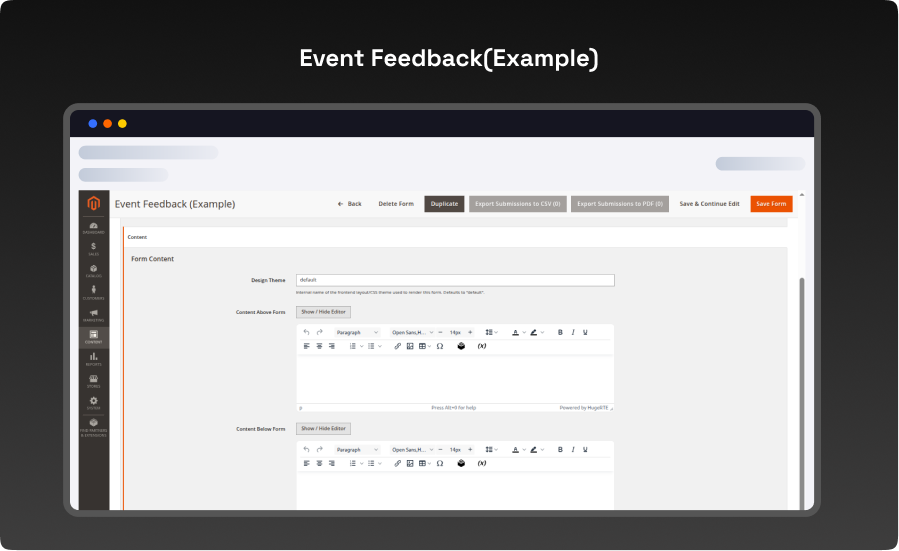
- Design Theme – Name of the layout/CSS theme used to display the form. Keep default unless you have a custom theme.
- Content Above Form – Text, images or links shown above the form. Click Show / Hide Editor to switch between the visual editor and HTML.
- Content Below Form – Text, images or links shown below the form.
Creator (Form Fields)
- This is where you design the form. Each row is one field:
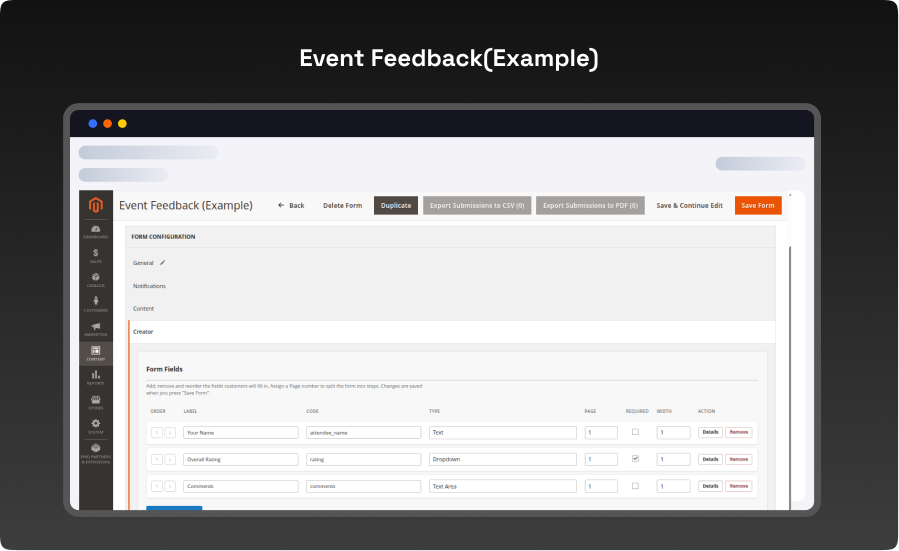
- Order (↑ ↓) – Move the field up or down.
- Label – The field name customers see.
- Code – A unique internal name for the field.
- Label – The field name customers see.
- Type – The kind of field (see the list below).
- Page – Page number (1–10). Use different numbers to split a long form into steps with Previous and Next buttons.
- Required – Tick to make the field mandatory.
- Width – Layout column setting for the field (1, 2 or 3).
- Details – Opens more options: Default Value, Max Length, Tooltip, CSS Class and Options. Click Done when finished.
- Remove – Delete the field.
- Click + Add New Field to add a row. Nothing is stored until you click Save Form or Save & Continue Edit.
Available field types
- Text / Text Area – Single-line or multi-line text.
- Email / Number – An email address or a number.
- Dropdown / Listbox (Multi-Select) – Choose one option, or several options, from a list.
- Checkbox / Radio Buttons – Tick boxes, or pick one option from a group.
- Date / Date Range / Time – A single date, a start–end date range, or a time.
- File Upload – Lets customers attach a file.
- Map / Location – A location picker (requires the Google API Key).
- Rating (1–5 stars) – A star rating.
- Address / Country – An address block, or a country selector.
- WYSIWYG / Rich Text – A formatted text editor.
- Hidden – A field not shown to the customer, which can carry a preset value.
- Section Heading – A field not shown to the customer, which can carry a preset value.
- Options for Dropdown, Listbox, Checkbox and Radio fields: click Details and enter one option per line. To
store a different value from the text shown, write Label|Value, for example Red|red. The value is what appears
in Submitted Data.
Embedding
- This tab gives you ready-to-use code for showing the form on your website. Replace the number in the examples with your form's own ID (shown in the tab). Choose the method that suits you:
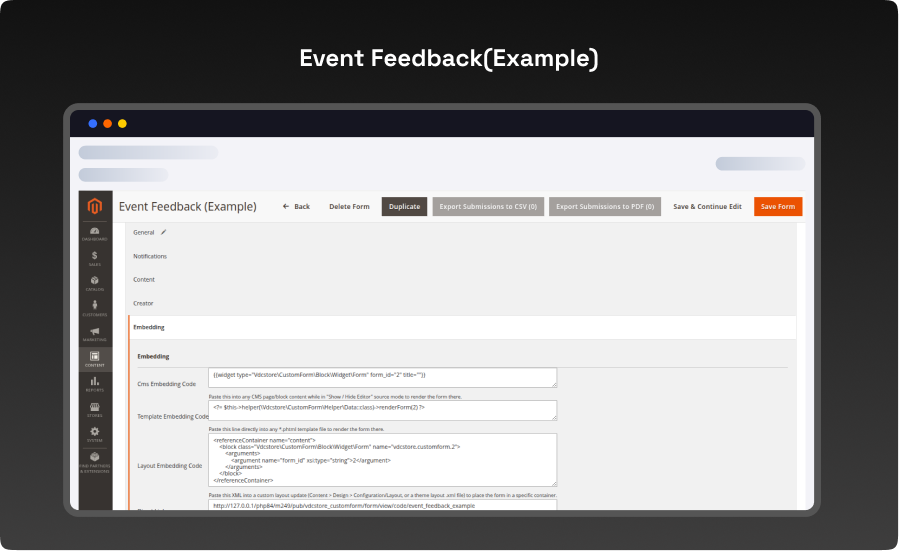
- Cms Embedding Code – Paste into any CMS page or block while in Show / Hide Editor source mode.
- Template Embedding Code – Paste into any .phtml template file.
- Layout Embedding Code – Paste into a custom layout update (Content > Design > Configuration/Layout, or a theme layout .xml file) to place the form in a specific container.
- Direct Link – A standalone page showing only this form. Share the link anywhere.
The Form on Your Store
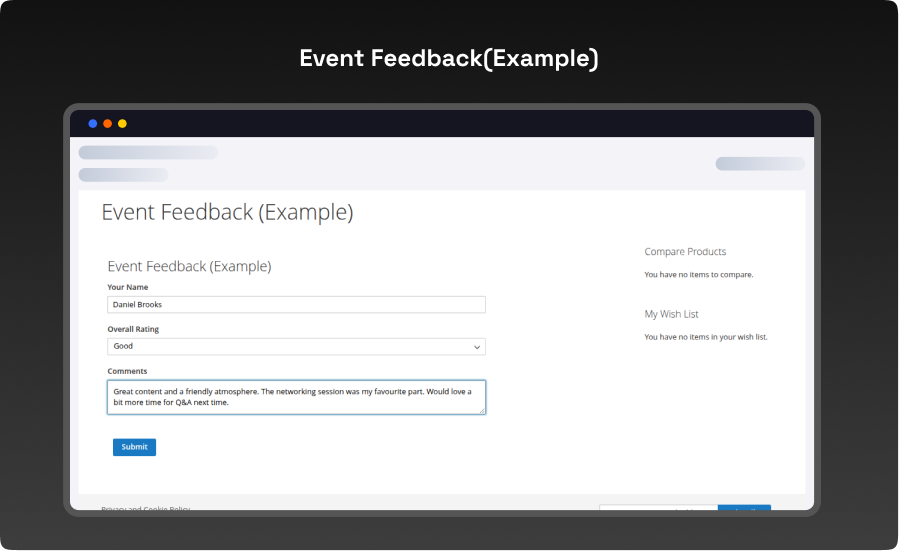
- Once the form is enabled and embedded (or opened through its direct link), customers see it on the
storefront. In this example the customer fills in Your Name, Overall Rating and Comments, then
clicks Submit. The success message you set in the General tab is displayed afterwards.
Submitted Data
- Go to Content > Custom Forms > Submitted Data to see everything customers have sent. Use the keyword search and Filters to find a submission quickly, and click View to open it.
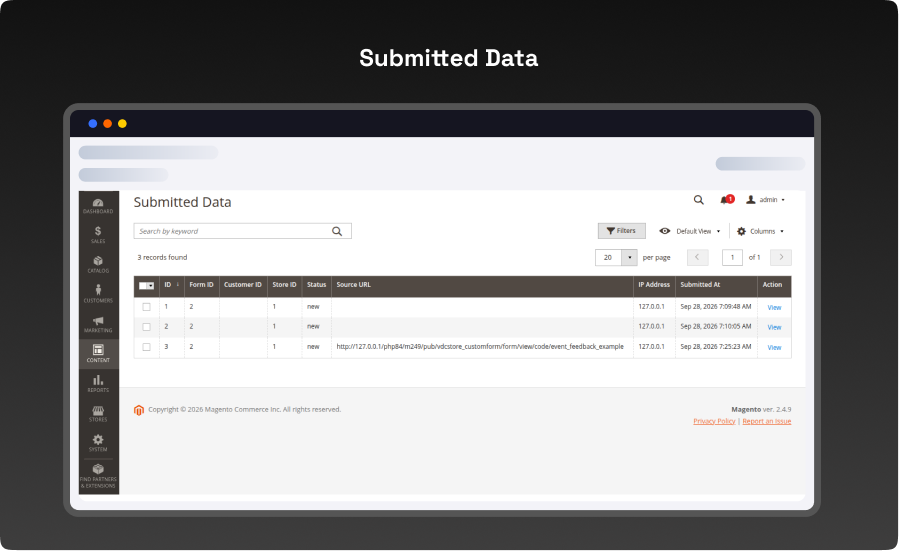
- ID / Form ID – The submission number and the form it belongs to.
- Customer ID – The customer's ID. Empty for guests.
- Store ID – The store view the form was submitted from.
- Status – new (not yet handled), replied (answered by email) or closed.
- Source URL – The page the form was submitted from, when available.
- IP Address / Submitted At – The customer's IP address and the date and time of submission.
Viewing and Replying to a Submission
- The submission page has three sections:
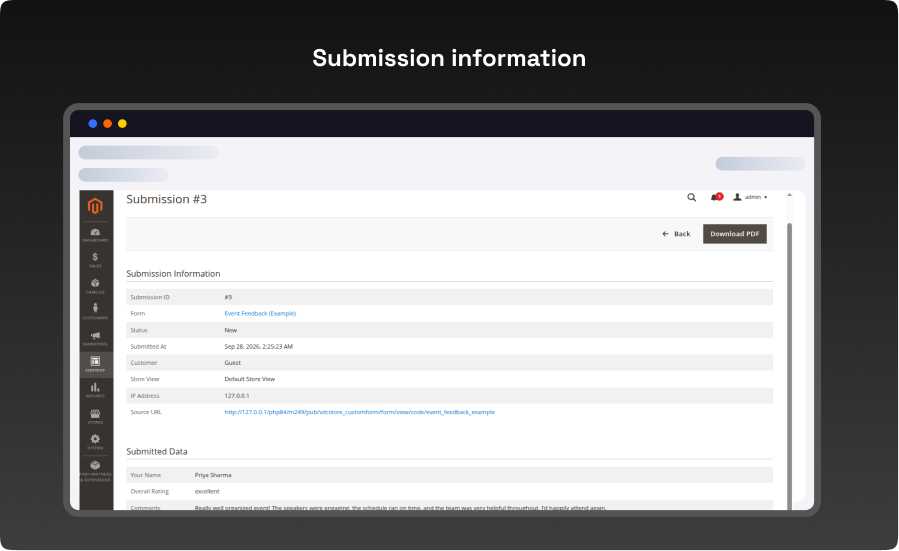
- Submission Information – ID, form, status, date, customer (or Guest), store view, IP address and source URL.
- Submitted Data – the customer's answers, field by field.
- Admin Reply – write and send an email reply to the customer. The status changes to replied after
you send it. - Use Download PDF to save the submission as a PDF file, or Back to return to the list.
- Note: if you see the message “Please choose a field to be used as an e-mail address in Email Address Field
setting of the form configuration”, open the form, go to the Notifications tab, select the field that contains the
customer's email in Email Address Field, and save the form. The example form has no email field, so add one in
the Creator tab first if you want to reply to your customers.
What you'll obtain with our Magento Technical Audit
With VDC Store's Magento eCommerce technical audit you'll gain expert separate in-depth analysis with an exhaustive summary of the state of your store's code grade and overall usability.

-

An organizational summary of discoveries with preferences and a brief overview
-
3rd party extensions initial review
-
An exact description of results and suggested solutions
-
Database innocence review (to secure that data is recorded precisely as planned)
-
Top preferences for your architects
-
Code quality examination (periodic reflection of your store source code)
-
Examination of possible Magento core design changes
-
Speed and execution analysis (HTTP requests, optimizations, exhale headers…)
By a technical appraisal, the client not only obtains information about the issues the store is facing but also this examination by VDC Store allows them to acquire beneficial information and concepts for setting up programs to enhance sales and conversion drivers.
Our analysis appreciates the essence of your business. We are not utilizing an automatic procedure that is used in every case. We want to make sure you end up with suggestions based on the exact condition of your store. Start the discussion about the Magento technical audit you're curious in by filling out the Contact Us form.
Why Choose the VDCStore Magento 2 Custom Form Extension
Every store has unique data-collection needs — whether it’s capturing quotations, surveys, product inquiries, returns info, customer feedback, or event registrations. The VDCStore Magento 2 Custom Form Extension empowers you to build unlimited forms with complete flexibility using various field types including text, textarea, dropdown, checkbox, radio buttons, file upload, and more. You get full control over form placement, validation rules, and email routing without any coding, enabling smarter interactions with your customers and streamlined data collection. Designed natively for Magento 2 and optimized for performance, this extension enhances engagement, supports business processes, and gives you the insights you need — all while keeping the experience intuitive for both admins and users.
Live Demo


Explore Our Customer Reviews
Dr Zahid
 Verified
Very happy with the website service!
Very happy with the website service. Great communication, high-quality design, and timely delivery. Everything was handled professionally, and the end result exceeded our expectations. Would definitely recommend.
Ravinder Gupta
VerifiedGreat experience
Great experience working with this software company. The team is professional, responsive, and delivered exactly what was promised.
Erel Support
VerifiedExtremely satisfied
I am extremely satisfied with the website they built for us. They listened carefully to our ideas, suggested improvements, and delivered a site that perfectly represents our brand.The process was smooth,strees-free,well organized.Great attention to detail and excellent support even after launch
Anurag Kumar
VerifiedGreat experience working with this team
We had a great experience working with this team for our website. They were Professional, responsive, and clearly understood our requirements from the start. The final website looks clean and modern and works perfectly across all devices. Communication was smooth throughout the project, and everything was delivered on time. Highly recommended for anyone looking for reliable website services and extensions.
Amol Bhoyate
VerifiedReliable, Professional, and High-Quality Web Development
We had a great experience working with VDC Store for our website development needs. From the very beginning, their team was professional, responsive, and attentive to our requirements. They clearly understood our vision and delivered a modern, user-friendly website that aligns perfectly with our business goals.
Comparison


Explore Our Hyvä Theme Demos
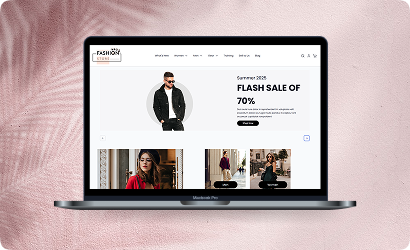
Fashion Store
Experience lightning-fast browsing and seamless product discovery in our Fashion demo, designed for smooth navigation and instant page loads.

Jewelry Store
Experience a sleek, lightning-fast browsing experience with our Jewelry demo — optimized for smooth navigation and instant product loading. Modern design meets high performance for flawless shopping.
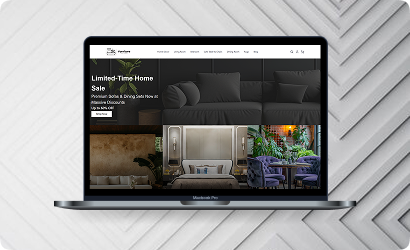
Furniture Store
Our Furniture demo delivers fast, responsive pages and seamless product filtering, letting users explore large collections without delay. Performance-driven design for ultimate online convenience.
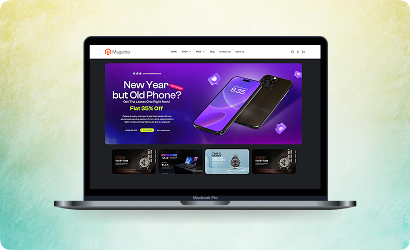
Electronics Store
Explore the Electronics demo with blazing-fast load times and smooth interactive features, ensuring a high-speed, immersive shopping experience. Optimised for tech-savvy customers.
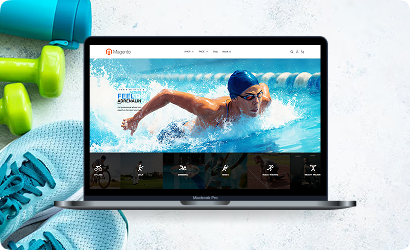
Fitness Store
The Fitness demo combines speed and responsiveness with effortless navigation, making it easy to browse workout gear and accessories quickly. Built for fast, engaging online fitness shopping.
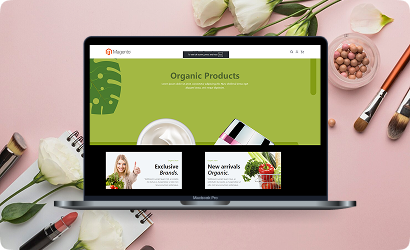
Beauty Store
Enjoy instant load times and smooth interactions in our Beauty demo, designed for a seamless, high-performance shopping journey. Perfect for browsing beauty products without interruptions.

B2B Store
Our B2B demo emphasizes speed and efficiency, handling bulk catalogs and quick ordering without lag. Engineered for high-performance business-to-business operations.
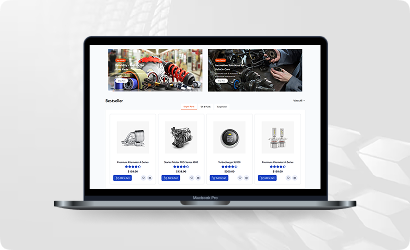
Auto Store
The Auto demo offers responsive navigation and rapid product searches, making car parts and accessories easy to find. Optimized for high-speed, performance-driven shopping.
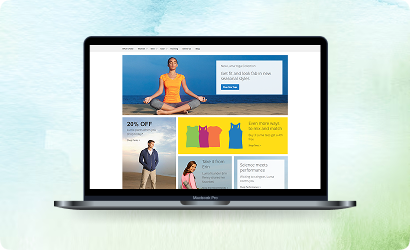
Hyvä Demo Store
Experience the Hyvä demo’s cutting-edge performance with near-instant page loads, smooth animations, and superior responsiveness. Designed for modern, lightning-fast eCommerce.
FANTASTIC AND PREMIUM CLIENTS
Trusted by







Need More Help?
Save time by starting your support request online and we'll connect you to an expert. Save time by starting your support request.